Why It's Time to Rethink Your IAM Strategy: The Strategic Case for a Modern Enterprise Directory

Christian Barbieri
Vice President, Technology

For decades, organizations have anchored their Identity and Access Management (IAM) strategy around Single Sign-On (SSO) and Identity Governance and Administration (IGA). These technologies have delivered critical value — streamlining access, improving compliance, and enhancing user experience. However, one foundational component has often been overlooked: the enterprise directory.
In most environments, Microsoft Active Directory became the de facto choice — not because it was strategically selected, but because it was already there. Its adoption was convenient, but its capabilities remained basic, rarely evolving in line with the growing complexity of modern IT ecosystems.
The New Forces of Complexity
Today, IAM faces new and unprecedented pressures:
- Cloud-first and hybrid architectures
- Bring Your Own Identity (BYOId) models
- Identity-as-a-Service (IDaaS) platforms
- External user onboarding and federated identities
- Zero Trust security frameworks
These forces are reshaping the identity landscape, and traditional IAM strategies are struggling to keep up. IGA systems — originally designed to centralize identity data and streamline governance — are now being asked to orchestrate sprawling, intricate provisioning workflows across disparate systems. This not only overburdens the technology but also increases operational risk and complexity.
The Problem with Overloading IGA
When IGA platforms are forced to manage every nuance of identity provisioning and synchronization across cloud and on-prem systems, they become increasingly fragile. Managing policies and workflows grows cumbersome. Auditing and compliance become reactive instead of proactive. Innovation slows to a crawl as IAM teams spend more time maintaining complexity than enabling business agility.
What's needed is a strategic shift — a new approach that places identity data at the center of the enterprise in a way that is scalable, resilient, and intelligent.
The Strategic Advantage of a Modern Enterprise Directory
The solution is a modern, centralized enterprise directory — designed to act as the identity backbone for the entire organization.
Unlike legacy directories, modern platforms are built to handle the complexity of today's identity landscape. They offer capabilities such as:
- Virtualization and abstraction layers to unify identity data across sources without duplicating it
- Real-time data aggregation from disparate identity systems and applications
- Centralized policy enforcement for fine-grained authorization and access control
- Native support for Zero Trust models that rely on dynamic, context-aware decisions
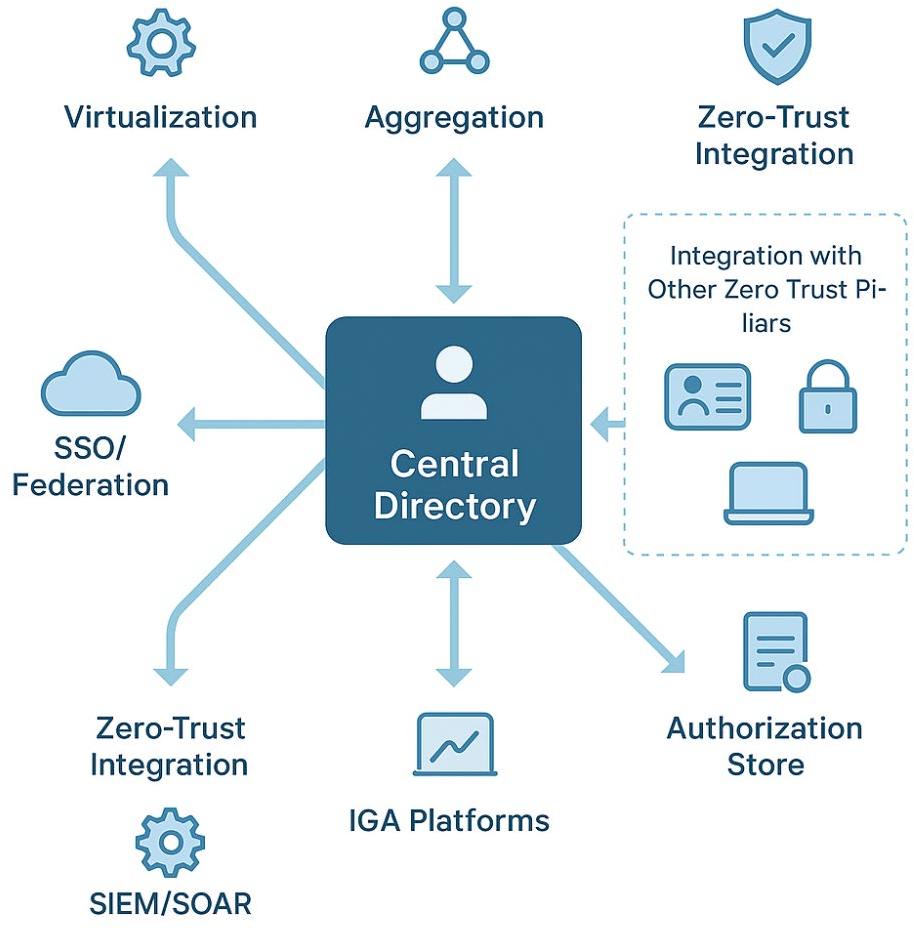
By introducing a smart directory layer into the IAM stack, organizations can offload complexity from IGA systems and eliminate the need for brittle, point-to-point provisioning workflows. The result is a more agile and scalable identity architecture — one that's better aligned with the realities of digital transformation.
Closing Thoughts
In today's rapidly evolving digital landscape, the enterprise directory is no longer a passive data store — it's a strategic enabler of security, efficiency, and innovation.
Forward-thinking organizations are already making this shift. They're consolidating identity data, reducing operational overhead, and laying the groundwork for more intelligent, adaptive IAM architectures.
If your IAM strategy is still leaning heavily on IGA and SSO while treating directories as static infrastructure, it's time to take a fresh look. The modern enterprise directory isn't just a technical enhancement — it's a business imperative.
Need help deploying ICAM or Zero Trust solutions? Contact Olympus Solutions — we'll untangle the tech so you can get back to business. Olympus Solutions Inc. can provide guidance, assist in implementation, and help you modernize your IAM strategy. Reach out today for expert guidance that helps you achieve your mission.
Originally published on LinkedIn.
Read the original on LinkedIn