The USB-C of AI Agents: Securing Autonomous Ops with the Model Context Protocol (MCP)

Jim Walker
General Manager, Service Delivery
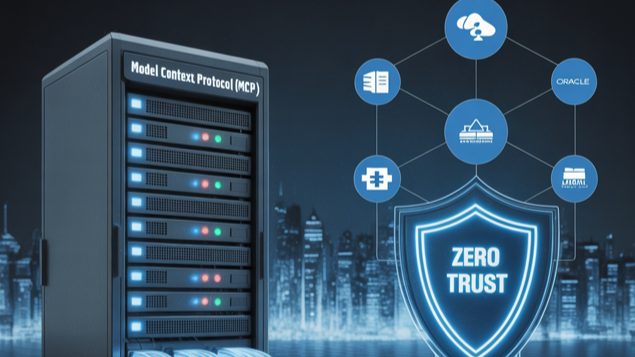
Remember the drawer full of proprietary chargers? That's enterprise AI integration today. USB-C fixed hardware chaos; MCP is fixing agent chaos — and for Federal environments where "chatty toy bots" are irrelevant, it's becoming the de facto standard for agents that must act under Zero Trust.
The Problem: Custom Integrations = Custom Attack Surfaces
You want agents that hit SharePoint, Oracle, mainframes, line-of-business APIs. Each bespoke connector becomes another unreviewed pathway for breach and compliance drift. Multiply that across N×M systems (N systems times M models) — welcome to risk debt.
Security Reality Check: Every custom integration is a potential breach vector that bypasses your standard security controls.
The Standard: Model Context Protocol (MCP)
MCP gives models a standardized, security-aware interface to tools and data. Microsoft is shipping broad first-party support across Windows, GitHub/Copilot Studio, Azure AI, and Semantic Kernel. OpenAI adopted MCP across its stack; Google confirmed Gemini support and now publishes MCP servers for Toolbox and Data Commons.
Why it matters
- Build once to MCP vs. one-off connectors — Executive view: dramatically reduce integration costs and maintenance overhead by standardizing on a single protocol. Technical view: a single SDK, unified error handling, and a consistent auth flow across all AI-to-system connections.
- Centralized controls and uniform audit trails — Executive view: one dashboard to monitor all AI actions streamlines compliance audits and improves security visibility. Technical view: structured JSON-RPC 2.0 logs with correlation IDs enable end-to-end tracing and SIEM integration.
- Zero Trust alignment with authentication, authorization, scoping, and least privilege — Executive view: AI agents follow the same security rules as your most sensitive human users. Technical view: OAuth 2.0 + RBAC + attribute-based access control (ABAC) with dynamic policy evaluation per request.
- Token audience binding — the June 18, 2025 MCP spec requires OAuth Resource Indicators (RFC 8707). Executive view: prevents stolen credentials from being used across different systems, like chip-enabled credit cards. Technical view: tokens explicitly scoped to resource URIs and validated at both the gateway and server layers, preventing confused-deputy attacks.
Reality Check: Year-1 MCP Lessons (Security First)
Early adopters prove both the scale and the risks. On scale: Block runs 60+ MCP servers powering workflows from code review to finance operations. On risk, three CVEs from the ecosystem's first year illustrate the stakes:
- CVE-2025-6514 — mcp-remote remote code execution via malicious OAuth endpoint handling. Impact: attackers could execute arbitrary commands on developer machines. Root cause: insufficient validation of OAuth authorization endpoints allowed URL manipulation.
- CVE-2025-49596 — Anthropic MCP Inspector localhost exposure leading to drive-by RCE. Impact: 560+ exposed instances vulnerable to browser-based attacks. Root cause: binding to 0.0.0.0 instead of 127.0.0.1, plus missing CORS controls.
- CVE-2025-53109/53110 — Filesystem server symlink/sandbox escapes granting full host access. Impact: complete system compromise from limited file-read permissions. Root cause: path traversal via symlinks plus inadequate input sanitization.
Takeaway: MCP is powerful, but it requires the same rigorous security controls as authentication gateways and API firewalls — not the permissive defaults often used in development environments.
A Federal-Grade MCP Roadmap (Fast, Safe, Auditable)
Phase 1 (Weeks 0–8): Proof of Value — Read-Only, Low-Risk Pilots
- Containerize every server (Kubernetes with PodSecurity + seccomp/AppArmor) — limits blast radius while proving value and contains breaches within isolated environments. Pod security at the "restricted" level, a read-only root filesystem, and no CAP_SYS_ADMIN.
- Scope file and network access to minimal — reduces attack surface and prevents lateral movement if pilot systems are compromised. NetworkPolicies with explicit egress rules; SELinux/AppArmor profiles for syscall filtering.
- Turn on end-to-end logging now (agent → gateway → server) — builds the audit fabric before privileges show up, enabling forensics and compliance from day one. OpenTelemetry spans with W3C trace context, shipped to the SIEM with appropriate retention.
Phase 2 (Weeks 9–16): Controls On, Privileges Up
- mTLS between all components, with short-lived tokens bound via RFC 8707 — mutual authentication prevents impersonation, stopping the exact vulnerabilities seen in CVE-2025-6514. Client-cert auth + 15-minute token TTL + audience-constrained JWTs with explicit resource URIs.
- Implement PAM for AI-agent credential management — agents need the same privileged-credential protection as your most sensitive service accounts, enabling rapid rotation if compromise is suspected. Vault-based storage, automated rotation, and session recording for audit.
- Gateway pattern: rate limits, DLP, anomaly detection, prompt-injection shields — a single policy enforcement point that prevents runaway agents and data exfiltration. WAF rules for prompt patterns, ML-based anomaly scoring, and PII detection via regex + NER models.
- Allow-listed server registry (no ad-hoc servers) — supply-chain attacks have already hit the MCP ecosystem; this blocks malicious lookalike servers. A Git-ops-managed registry with Sigstore signatures, SBOM generation, and dependency scanning.
Phase 3 (Weeks 17–24): Production + Governance
- IAM and PAM integration: agent identities, credential lifecycle, separation of duties — prevents orphaned agents with excessive permissions and static credentials. Service principals with SCIM provisioning, PAM-managed rotation, and automated access reviews.
- SOC playbooks for MCP scenarios — traditional playbooks don't cover AI-specific attack patterns. SOAR workflows for prompt injection, token abuse, and behavioral anomalies, with automated containment.
- Continuous compliance with RMF/FISMA/FedRAMP mappings — maintains Authority to Operate (ATO) as capabilities evolve. OSCAL-based control mapping, automated evidence collection, and regular compliance scans.
Yes, 24 weeks seems aggressive. It is. But waiting means deploying yesterday's security for tomorrow's threats.
The Five Controls That Determine Success
- 1 Default-Deny Network — bind to localhost/private subnets only; no 0.0.0.0 exposure. Prevents Inspector-style drive-by attacks (CVE-2025-49596 affected 560+ exposed instances found on Shodan). iptables/nftables rules enforcing local-only binding; cloud security-group deny-all defaults.
- 2 Filesystem Lockdown — exact-path allow-lists, read-only where possible, reject symlinks. Prevents sandbox escapes (CVE-2025-53109/53110 turned limited file access into full host compromise). chroot jails + mount namespaces + O_NOFOLLOW flags + realpath validation.
- 3 Supply-Chain Discipline — curated server registry, no direct npm/pip pulls, signed artifacts with hash pinning. Prevents malicious servers (the postmark-mcp attack silently forwarded all emails to attackers). A private artifact repository + Cosign signatures + SLSA Level 3 attestations.
- 4 Credential Management Excellence — PAM-controlled credentials, automated rotation, no hardcoded secrets. Prevents static-credential compromise and lateral movement. Vault integration + just-in-time provisioning + automated rotation policies.
- 5 Behavioral Monitoring — alert on new server registrations, cross-boundary access, and unusual tool-call volumes. Enables detection of exfiltration attempts before significant data loss. eBPF probes + Falco rules + custom Sigma detections for MCP-specific patterns.
Executive Summary
- MCP = a universal adapter for AI agents
- Risk = each custom connection is a potential breach
- Solution = one standard, centralized security
- Timeline = 6 months to production-ready
- Investment = less than one major breach cleanup
- ROI = significant reduction in integration complexity and faster deployment cycles
Where This Lands by 2026
- Windows + MCP hardens the endpoint story (Microsoft calls MCP the "USB-C of AI apps").
- OpenAI + Google + Microsoft alignment means fewer custom bridges and more policy-driven controls.
- Result: agents that actually do work in government — benefits processing, cyber triage — without torching your ATO.
Federal Success Metric: Can your AI agent pass the same security review as a new contractor with system access? If not, you're not ready.
Your Next Moves (One Sprint Each)
- 1 Inventory current agent/tool connectors — flag non-standard and high-privilege paths. Deliverable: a risk-scored inventory with a remediation timeline.
- 2 Pick two read-only pilots (e.g., SharePoint search + ticketing lookups) behind the gateway. Deliverable: a working proof-of-concept with security controls.
- 3 Stand up IAM and PAM for agents (service principals, credential management, lifecycle governance). Deliverable: an agent-provisioning runbook with integrated credential rotation.
- 4 Write two SOC runbooks: "localhost RCE" and "token audience mismatch." Deliverable: tested response procedures with rapid-response targets.
- 5 Adopt the June 18, 2025 spec controls (RFC 8707 resource indicators on every token). Deliverable: updated auth infrastructure with audience validation.
For Different Audiences
- For CISOs: start with a risk assessment of current AI integrations.
- For Architects: download the MCP spec and identify pilot systems.
- For Developers: join the MCP community and review reference implementations.
- For Compliance: map MCP controls to your existing RMF/FISMA framework.
The Six-Month Vision
Six months from now, your agents will be processing clearances, analyzing threat intelligence, and automating compliance checks — all under Zero Trust controls that would make your security team smile. The question isn't whether to adopt MCP, but whether you'll lead the secure implementation or scramble to catch up.
Ready to build your secure MCP implementation? Let's connect and discuss how to align AI agents with your Zero Trust architecture. With deep Federal-sector experience and expertise across leading identity and access management technologies, Olympus Solutions helps organizations deploy AI that works — and protects.
Originally published on LinkedIn.
Read the original on LinkedIn